AMTA Government Relations Update August 12, 2026
August 12, 2026 09:00 AM
May-July 2026 GR Activities
AMTA government relations staff continue to monitor and respond to federal and state legislation and agency activity that impacts the music therapy profession and music therapy consumers. Given the current climate in our nation, the intensity of this activity has been significant. Actions and decisions related to healthcare and special education service access, professional education issues, and research funding support all have the potential to dramatically change how our country responds to community needs.
Federal Coalition Updates and Sign-On Letters
Consortium for Constituents with Disabilities (CCD)
In June 2026, the Office of Legal Counsel within the Department of Justice released a memo stating that neither the Americans with Disabilities Act (ADA) nor Section 504 of the Rehabilitation Act of 1973 contain an integration mandate. The integration mandate is the right of people with disabilities to live and receive services in the most integrated setting appropriate to their needs. AMTA was represented within a statement from the Consortium for Constituents with Disabilities (CCD) condemning the memo which attacks and undermines disability rights.
“The Department’s memo does not change the law. It has not been accepted by a court. The rights of people with disabilities to live in their own homes and communities are well established by law and cannot be changed by an agency. This effort to nullify the civil rights of people with disabilities must be soundly rejected.”
CCD Education Task Force
As the Administration continues its plan to eliminate the U.S. Department of Education (ED), it was recently announced that a new interagency agreement has been created, moving the Office of Special Education and Rehabilitative Services (OSERS) to the Department of Health and Human Services (HHS). The disability community and special education providers have voiced concerns with this most recent agreement and outreach to members of Congress has been initiated. There are fears that HHS staff do not have the expertise regarding IDEA implementation to successfully serve students. Thanks to our involvement in the CCD Education Task Force, we recently supported this letter opposing the Department of Education’s actions.
Additionally, AMTA joined a broad coalition letter that included over 450 organizations specifically opposing the ED's actions that transfer responsibilities from the Office of Special Education and Rehabilitative Services (OSERS) to the Department of Health and Human Services (HHS) and the Office for Civil Rights (OCR) to the Department of Justice (DOJ).
Broad Coalition of Disability, Civil Rights, and Education Organizations Denounces ED’s Latest Transfers of Core Functions
Advanced Professional Workforce Alliance (APWA)
APWA supported a congressional briefing on June 8, 2026 concerning the RISE Act. As a result of a lawsuit filed by Attorneys General of 25 states and additional lawsuits regarding the arbitrary definition of professional degrees, ED has released updated guidance on the list of professions eligible for higher graduate student loan limits. Advocacy continues with members of Congress through the introduction of 8 pieces of legislation that address ongoing concerns about the Reimagining and Improving Student Education (RISE) Final Rules.
Coalition to Preserve Rehabilitation (CPR)
As members of the Coalition to Preserve Rehabilitation (CPR), AMTA signed onto comments submitted to the Center for Medicare and Medicaid Services (CMS) regarding Fiscal Year 2027 Inpatient Rehabilitation Facility Prospective Payment System Proposed Rule. CMS publishes proposed rules each year that outline plans for reimbursement of covered programs and offers public comment periods before final rules are established.
Disability and Rehabilitation Research Coalition (DRRC)
AMTA joined our colleagues within the Disability and Rehabilitation Research Coalition (DRRC) in a letter of concern to the Department of Health and Human Services (HHS) regarding funding delays impacting the National Paralysis Resource Center. AMTA also signed on to a coalition comments submission to the Office of Management and Budgets (OMB) proposed rule revising the Uniform Guidance for Federal Financial Assistance. The comments expressed strong opposition to this proposed rule as it would fundamentally alter longstanding principles that have governed federal research funding for decades. DRRC is a coalition of national non-profit organizations committed to improving the science of medical rehabilitation, disability, and independent living. Focused on increasing and leveraging federal resources devoted to medical rehabilitation, disability, and independent living research, DRRC’s goal is to improve the ability of individuals with disabilities to function and live as independently as possible.
State Highlights
In collaboration with the Certification Board for Music Therapists (CBMT), AMTA continues with State Recognition Operational Plan implementation.
Current Activities include:
- Participated in or supported legislative, agency, and/or task force meetings in Alabama, California, Delaware, Florida, Illinois, Indiana, Kentucky, Massachusetts, Minnesota, Mississippi, North Carolina, Pennsylvania, Tennessee, Washington, Wisconsin, and Wyoming
- Represented AMTA and CBMT as exhibitors at the National Conference of State Legislatures (NCSL) Legislative Summit in Chicago, July 27-29, 2026. This annual event provides an outstanding opportunity to connect with senators and representatives from across the country, educating them about music therapy, answering questions, and celebrating state recognition successes.
State of the States Map
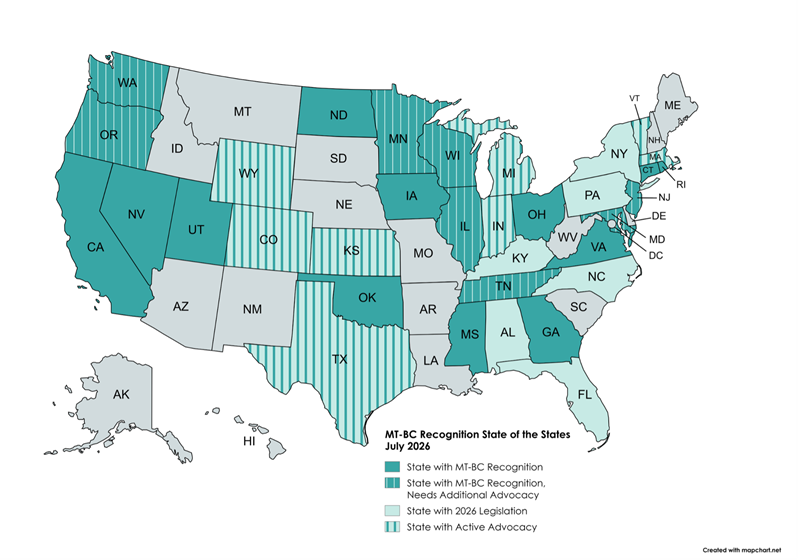
As we enter the "summer recess" for Congress and prepare for the upcoming election season this fall, we hope you will engage in whatever level of advocacy fits your schedule. Consider meeting with your state and federal legislators as they attend local events and begin their campaigns. Let them know you are a music therapist in their district and invite them (as allowed) to observe music therapy in action. Educate decisionmakers about the benefits of music therapy and how we need their support to increase access to quality services for their constituents. Remember, legislators can only support the issues they know about, and they need to hear your perspective and suggestions for improving your community. Thank you for your advocacy!
Back